Roundtable on Seawater Desalination for Hydrogen - Best Practices, Technology and Regulation
2 December 2025, online
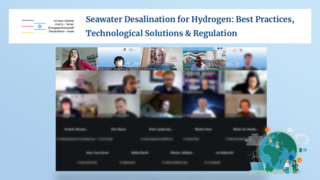
On 2 December 2025, a closed-door online roundtable brought together selected experts from Israel and Germany to discuss the role of seawater desalination for hydrogen production, with a particular focus on offshore applications.
While Germany could rely on water abundance for a long time, dry periods, reduced rainfall, and declining groundwater levels increasingly require us to rethink water security strategies and include alternative water sources. Seawater desalination is one such option; and for specific applications like offshore electrolysis for green hydrogen production off the German coast, it will be indispensable.
Israel, by contrast, has decades of experience in managing water scarcity. Seawater desalination is a core pillar of its national water strategy and is embedded in a sophisticated regulatory and technological framework.
The roundtable therefore aimed to connect Israeli best practices with German requirements and challenges, and to identify concrete avenues for further bilateral exchange.
Israel’s Water Desalination Landscape
Israel currently operates six large-scale desalination plants supplying a significant share of national drinking water demand. Desalination is critical infrastructure and governed by a multi-agency regulatory framework covering environmental protection, water quality, marine ecosystems, and long-term planning. Strict requirements for brine discharge and environmental impact assessments are considered international best practice.
Technological pathways for sustainable desalination
The main source of emissions in desalination lies in the energy demand of high-pressure pumps for e.g. reverse osmosis. Key levers for improving sustainability include higher pump efficiency, low-carbon electricity supply, and waste heat utilisation.
Requirements for offshore hydrogen production
For future offshore hydrogen projects, desalination is essential to ensure a reliable supply of ultra-pure water for electrolysis. Key challenges identified include limited space offshore, energy fluctuations, maintenance constraints, and, critically, the lack of a clear regulatory framework for brine discharge.
Looking Ahead: Opportunities for Further Exchange
Several concrete opportunities to deepen the dialogue were highlighted, including:
- Further technical deep dives into the interfaces between desalination and hydrogen production
- Analysis of international projects combining desalination with large-scale hydrogen production
- Targeted exchanges on regulatory frameworks and permitting processes, particularly in the offshore context
- Smaller bilateral or thematic expert discussions to strengthen professional cooperation
The roundtable underlined the value of international knowledge exchange in addressing emerging challenges at the intersection of water security and the energy transition. Building on Israel’s long-standing experience and Germany’s evolving needs, the German-Israeli Energy Partnership offers a strong platform to continue and deepen this dialogue.